


With Pain the First Thing We Lose is Language
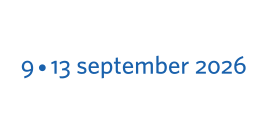
How can one write about Palestine? This is the central theme of the interview with Adania Shibli conducted by Paola Caridi in Mantua's Piazza Castello
For Palestinian novelist, essayist and playwright Adania Shibli, narrating her land and her people, though difficult, feels necessary. Writing is not a tool, "It's existing!".
Two of her books, Senses and Minor Detail, have been published in Italian by La Nave di Teseo. Both take place in Palestine. Both deal with the matter of form. Palestine is constantly being narrated by Israel, a rational oppressor whose narrative is simple, all-encompassing, and seemingly clear. On the other side, the Palestinian language has been broken, it trips and stumbles, struggling to tell a complex and excruciating truth. Shibli’s parents, she recounts, survived the Nakba, but would never tell her about it. When she was a kid, she was angry at them for their silence. But now she understands their sorrow, she feels it too, as if there are no words to describe what is happening to her people. "Still, I write. It’s a painful love, but it’s there", she concludes.
Senses, first published in 2007, is characterized by the absence of names of people and places, an undetermined space, an incapacity to communicate. But the text is full of precise details of the everyday life of a Palestinian girl, told through five chapters, each dedicated to a specific sense. By doing so the author gives depth to a place and a people that we, the Western audience, risk of perceiving only as an issue, a question.
Minor Detail, published in 2017, contains two apparently distinct narrations. One is set in 1949, one year after the Nakba, and tells the story of a young Palestinian woman, raped and killed by Israeli soldiers. The style recalls that of the Israeli narration: precise, cold, clear. The other story is about a girl that gets obsessed with this 'minor detail', after discovering she has a connection to it. The style here reflects the fears and anxieties of the once again nameless protagonist who, for the first time, visits historical Palestine.
Central to both novels are the forensic representation of everyday reality and the very conscious act of withholding names. What Adania Shibli accomplishes is thus a detailed narration of the Palestinian land, its people, as well as their erasure. We hear about Palestinians on TV or on social media everyday, but their names fail to reach our ears. Even through a nameless narration, explains Shibli, the reader can connect to them, and through literature, we can exercise our humanity.